Seeing it without being taught — the Zero-Training AI that high-mix, low-volume floors asked for
Zero-Training AI, aimed at the high-mix, low-volume line
What this article covers
AI visual inspection is going into more and more factories. Listen to the people running it, though, and the same things keep coming up: the training is hard work, operating it takes more effort than expected. On lines where the product variant changes often — high-mix, low-volume production — running AI is harder than anyone imagines.
If you have put AI visual inspection in yourself, you will recognise the complaints. Those very complaints produced a new idea: Zero-Training AI.
Here, using a fruit sorting line as the example, is what makes it hard, and what Zero-Training AI is for.
An AI model that needs adjusting per variant
Think of apples and mandarins being inspected on the same line. In industrial terms, different part numbers.
Apples today, mandarins tomorrow. Each changeover means adjusting the lighting and swapping the AI model. And it is not only changeovers in volume production that are awkward: even within one fruit, the colour, the texture and the shape differ, the same AI cannot be reused, and each needs adjusting separately. That is the reality of running a high-mix line.
On top of which, each variant has its own defects, and some of them occur very rarely.
Meanwhile, conventional defect-learning AI cannot learn at all unless the defect images accumulate; and good-product learning, if it is to absorb the variation in good products, wants an enormous number of images. Learning one defect with defect-learning AI typically needs tens to hundreds of images; good-product learning needs hundreds to thousands, depending on how much good products vary.
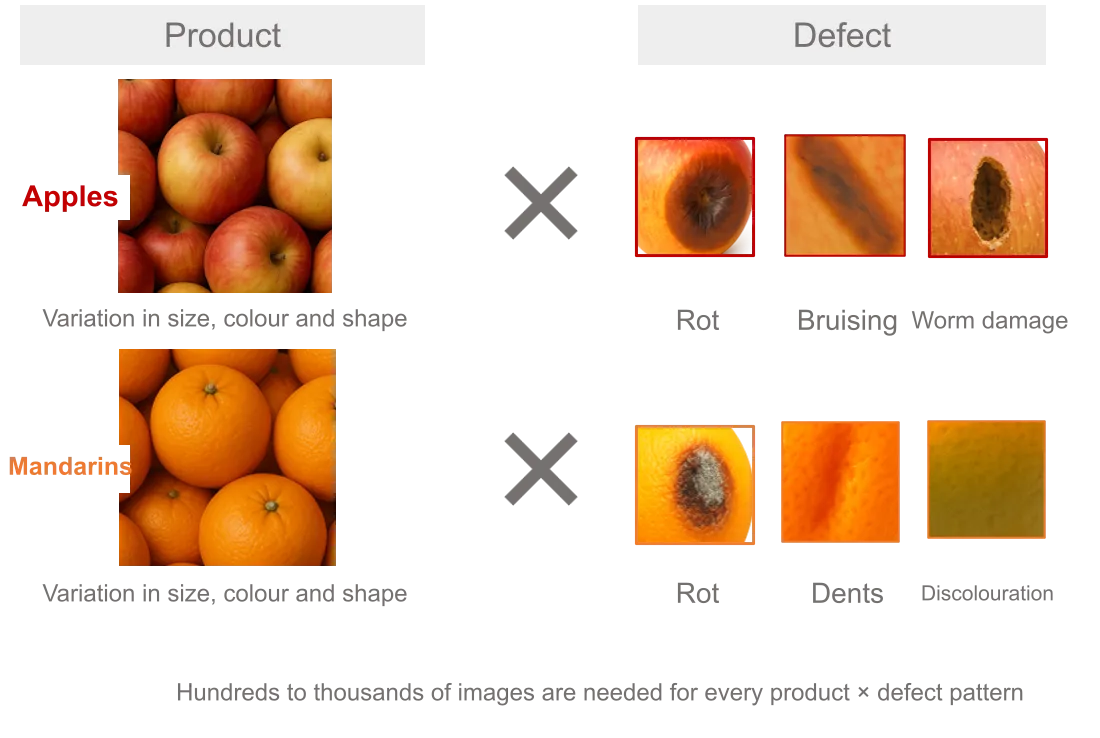
What the training data for apples and mandarins looks like
Because preparing that data is so much work, high-mix lines that wanted AI could not get it started. That situation went on for a long time.
Nor does it end at installation. Conventional AI visual inspection cannot judge a new situation by itself, so every added variant and every new defect meant a person re-teaching the AI.
For more on the AI used in visual inspection, see our other article.
The kinds of visual inspection AI and how they work, from inside the industry
The turn towards an AI that thinks — Zero-Training AI
What broke through that structural wall is the Zero-Training AI we developed, described in the article below. It is patented technology of ours.
Want AI inspection but cannot collect defects? That is what Zero-Training AI is for
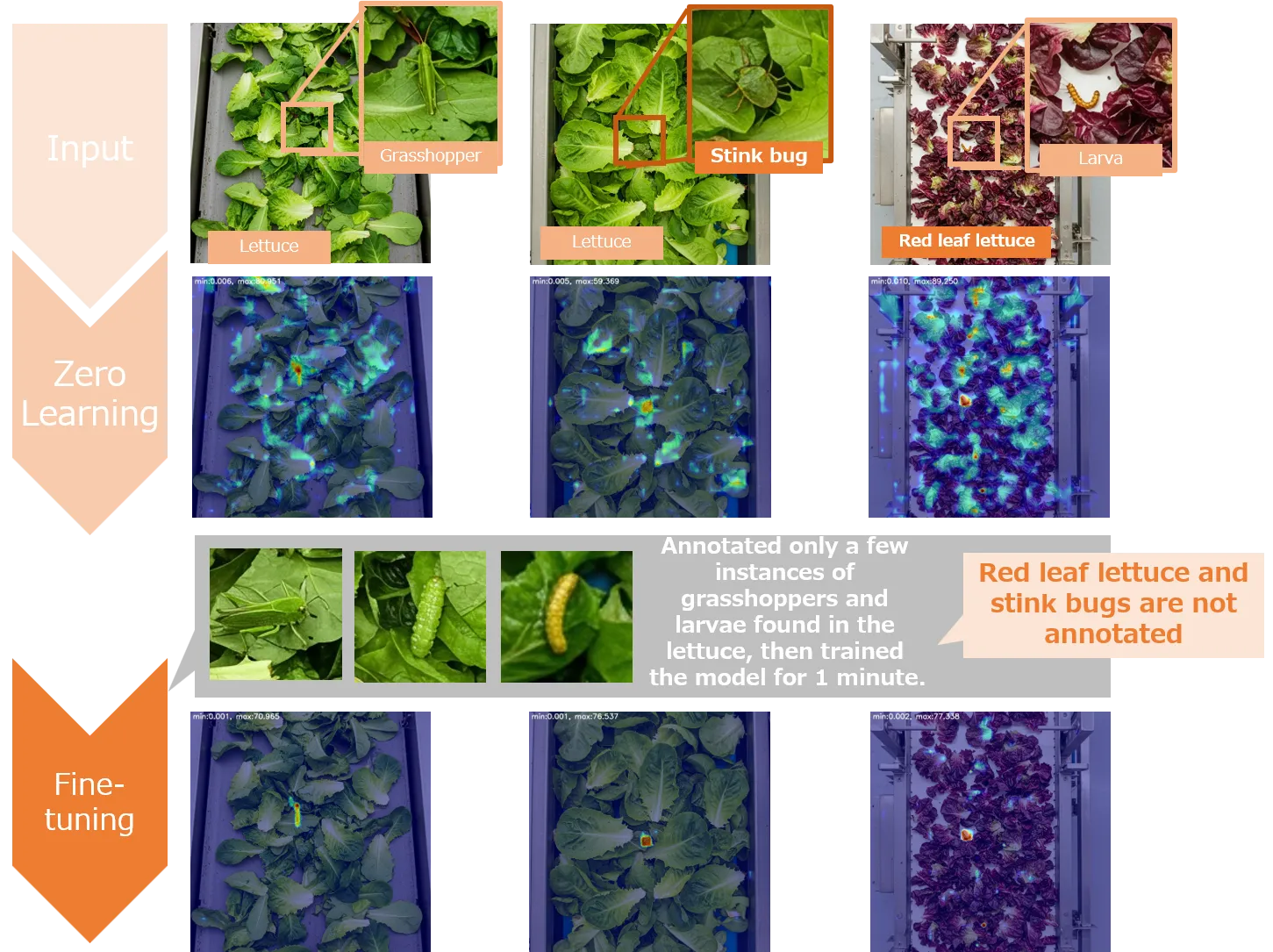
Zero-Training AI has learned, in advance and from a wide range of images, a common sense about products and a concept of what an anomaly is. Straight out of the box it can catch a defect as something that feels wrong. Which is to say that for a kind of fruit it has never seen, and a defect that occurs on it, it can judge for itself: this is not normal, this is unlike the rest. None of which is particular to fruit or food — industrial products behave the same way.
Fine-tune it on a few images containing the defect and it takes in that defect’s characteristics immediately, and the inspection result follows.
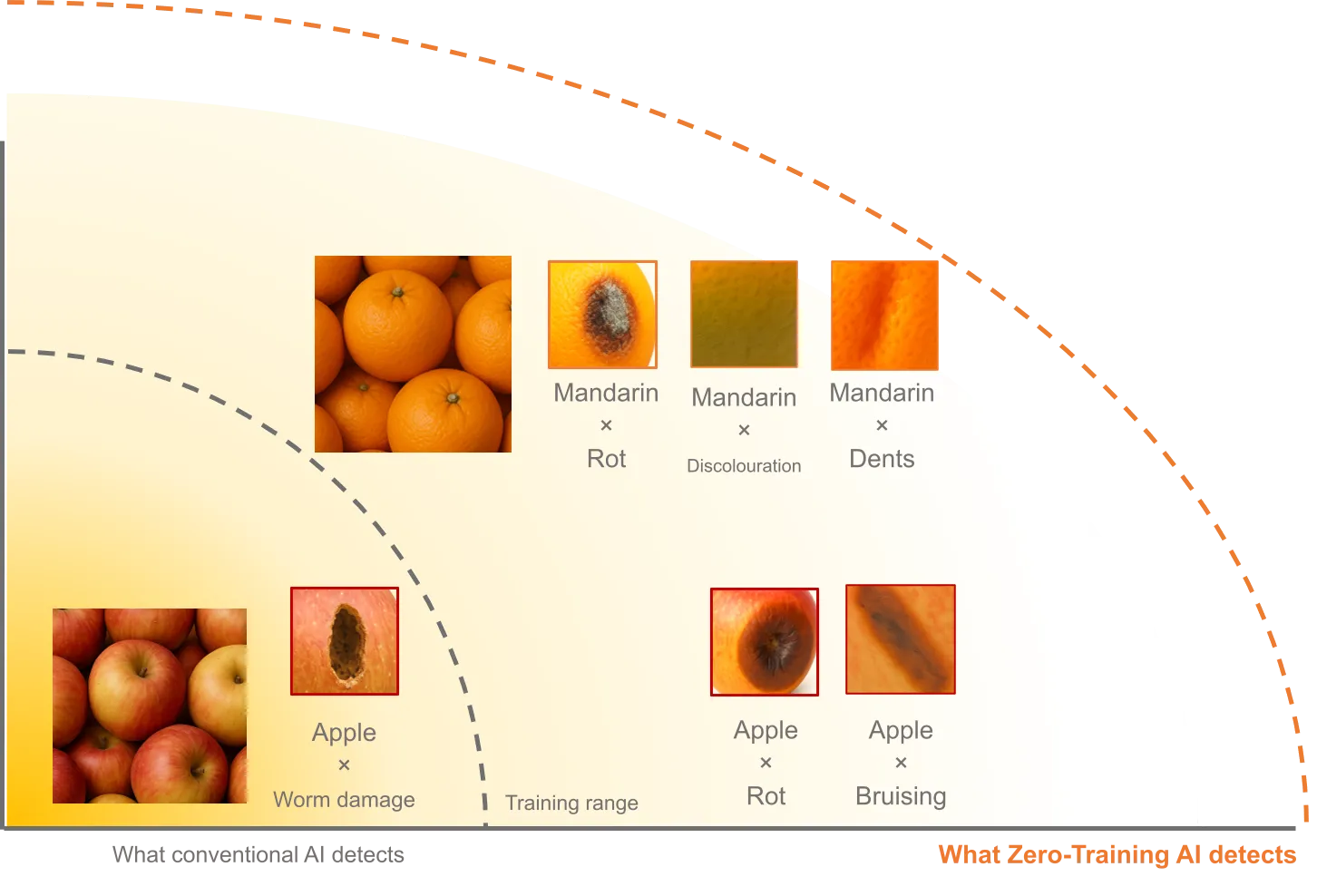
Comparing what the AI learned with what it can detect makes the difference plainest. Conventional AI could detect the patterns it had learned as good or as defective, and no further (inside the grey dashed line). Zero-Training AI holds what it learned as a concept, so it applies beyond the range it was trained on (inside the orange dashed line).
The difference in what is learned and what can be detected, conventional AI against Zero-Training AI. The grey dashed line is the range conventional AI detects — only what was in the training range: apples, and worm damage on apples. The orange dashed line is the range Zero-Training AI detects, which also covers mandarins with rot, discolouration and dents, and apples with rot and bruising, none of which were trained.
Because the concept is understood, the detection range extends — and so the process that used to take up to several months (collecting good and defective samples, capturing them, building the model) has come down to something that can be tuned while trying it on the line. Instead of gathering a mass of images over months and then waiting hours or days for the AI to train, you prepare a few images on the spot, let the AI train for a few minutes, and look at the result there and then.
In closing
Zero-Training AI is not merely a step forward in AI. It is a mechanism that supports high-mix, low-volume production — Japanese manufacturing as it actually is.
Few defects, many variants: the floors you see everywhere in Japan are exactly where it stands out. Zero-Training AI makes dealing with the unknown possible, which conventional AI was poor at, and makes inspection more flexible while cutting the work of training drastically.
We are after a future in which AI does not add to people’s work but thinks alongside them and puts the knowledge of the floor to use. For a demonstration of Zero-Training AI, or to talk about bringing it in, do get in touch.