
Visual inspection guidebook
From designing the capture setup to choosing the AI, talking to the line, and running the project
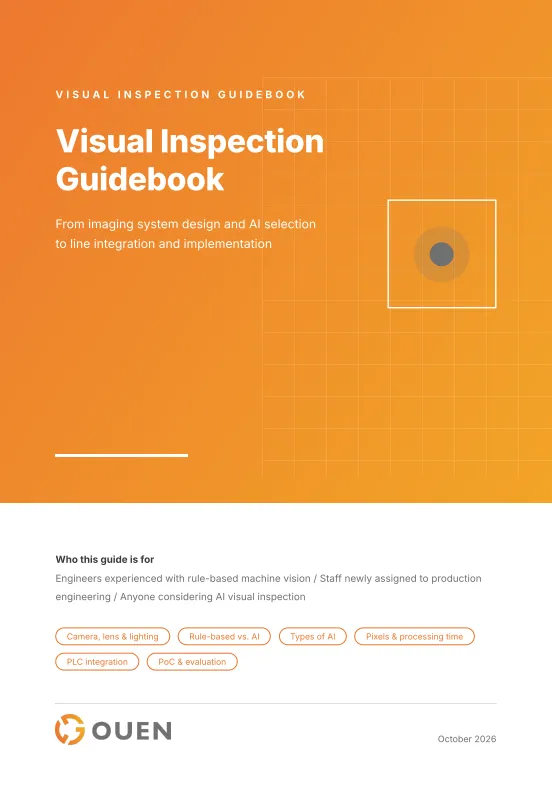
When you set out to automate a visual inspection, the first fork in the road is not which AI to use. It is whether the camera, the lens and the lighting can put the defect into the image at all. What is not in the image cannot be found, however good the logic downstream.
This guidebook runs from that capture design through to when a rule-based check beats AI and when it does not, how the system talks to the line, and how to run a PoC. Eight chapters, 62 pages. It is not a manual for one product; it is the groundwork anyone evaluating automated inspection ends up needing.
Who it is written for
The chapters stand on their own, so reading only the part you need works.
- Engineers who have worked with rule-based image inspection
- People newly assigned to production engineering
- Anyone evaluating AI visual inspection
What is in it
Eight chapters, plus a pre-project checklist and a glossary at the back.
01The shape of a visual inspection
The four stages an inspection rests on. Why deciding what counts as a defect is where automation starts, and how limit samples put that boundary into shared terms. Why AI does not remove the need for the definition.
02Designing the capture setup
Working back from the defect to the camera, the lens and the lighting. Area against line scan, bright field against dark field, choosing a wavelength. Worked examples taking defect size to the resolution it demands.
03Rule-based or AI
Writing the criteria yourself, or learning them from data. What each is good and bad at, and how they differ in explainability and in upkeep. Why a growing pile of exceptions is the signal to consider AI. Using both together.
04The kinds of AI
Differences in output — classification, detection, segmentation — and in how they learn, supervised or unsupervised. How much data each wants, and what matters more than the number of images. Zero-Training AI, which needs no training on site.
05Pixels, resolution and processing time
What the resizing and tiling that happen inside the software do to detection and to time. Where the processing time goes, and how to choose the PC. What to ask when comparing vendors.
06Choosing a method, by example
Three questions that narrow it down. How the kind of defect and the nature of the work give you a first candidate, with worked examples by subject.
07Integration and automation
Capture triggers, when to use DIO and when PLC communication, what to agree for fault conditions. Takt time and the timing through to ejection, and designing so a result is never matched to the wrong part. Logging and traceability.
08Running the project, and where it goes wrong
How to run a PoC and carry it into production. Gathering data when defects are rare. Whether to favour missed defects or false ones. Setting the rule for retraining, and the traps people fall into.
Request the guidebook
Fill in the form below. We will send the guidebook to the email address you give us.
The personal information you provide is handled under our privacy policy, and kept in line with our information security policy.