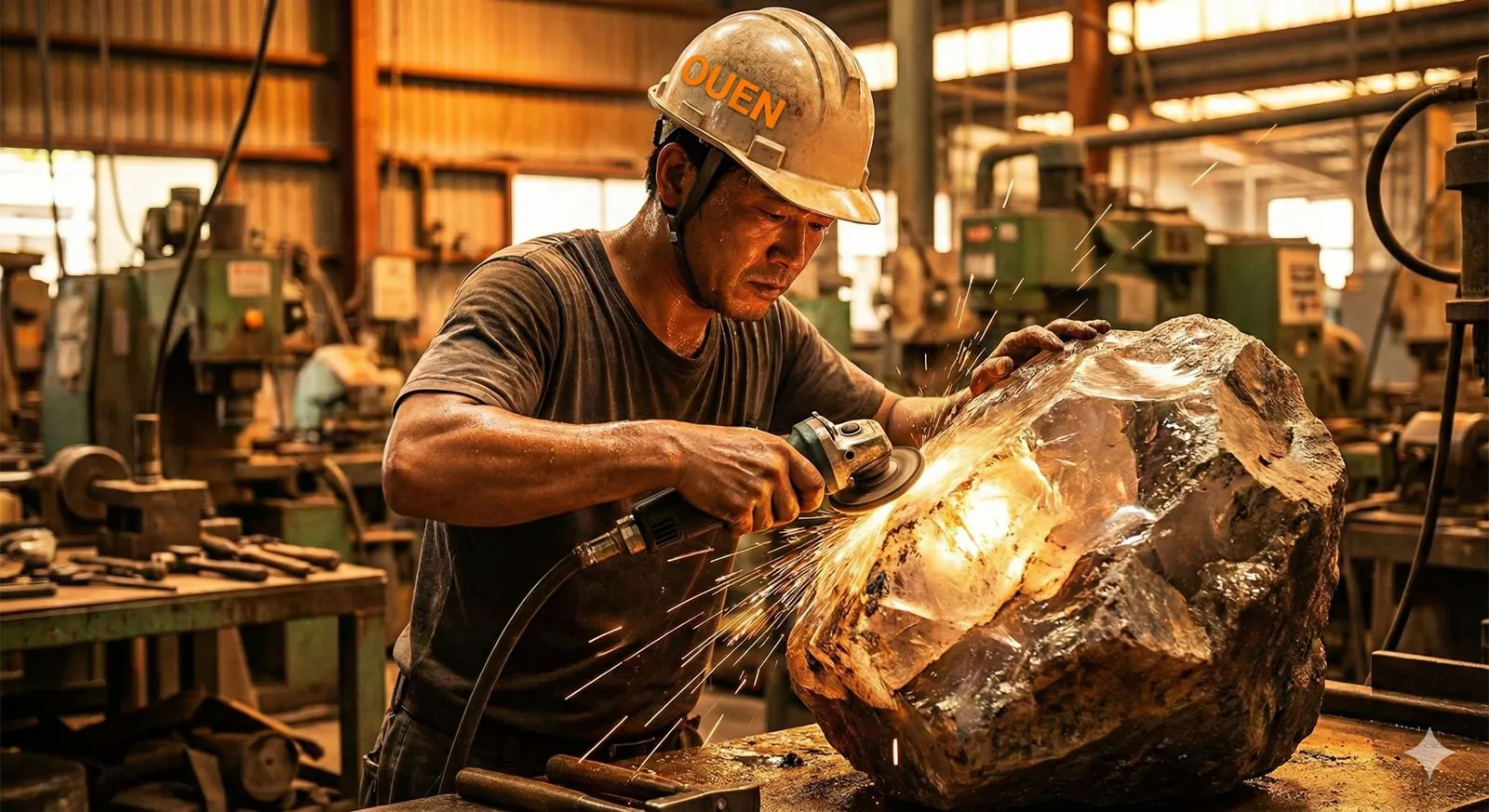
A non-programmer built a small app with generative AI — and found that thinking matters more than building
What ability actually matters now: what a non-programmer learned about thinking
What this article covers
What a non-programmer noticed while using AI to write a program, and what ability actually matters now, in four parts.
- Why someone who does not write code ended up building software for internal use
- How the development went, and what to watch for
- What it felt like in practice, and the traps
- How OUEN thinks about working with AI
Noticing the problem
It started with an offhand remark while someone was preparing material for a customer.
“Cropping images is quietly annoying, isn’t it.”
Since we propose visual inspection systems, handling image data is simply part of the work. To make a defect legible on a slide when the whole-frame view hides it, we crop and enlarge far more than most document work calls for.
Cropping one spot out of a few images is fine. But sometimes it means cropping several regions out of one image, resizing them and laying them out, over anything from a handful to more than ten images. That takes a serious amount of time, every time. And the work is not going away.
“Could we build something small and make it quicker?” From that thought, a colleague who does not write code set out to build an app with generative AI.
Their programming skill was close to beginner. What they did have: a VS Code environment already set up from an earlier urge to try Gemini CLI, and the habit of using ChatGPT to organise their thinking.
So, a beginner, a tool to make image cropping quicker, and the agentic AI Gemini CLI running inside VS Code.
How it went, and what mattered
1. Pin down what it has to do
The first job was being clear about the specification. Where does the current work actually take time? Which parts could software do? Is it genuinely worth building? With that sorted out, they wrote down the functions, the behaviour and the layout as plain text.
They had no idea which language would be best, so they gave no instruction and left that to the AI.
2. Hand the specification over and prototype
Then the specification went into Gemini CLI. Reading the code it proposed and the questions it asked, the app took shape bit by bit. Whatever was missing, and whatever needed changing once it had been used for real, got fixed as they went. It felt rather like pair programming with the AI.
3. Choose which improvements to make
What became clear here is that improvement has no end. As the software starts to look finished, the notices keep coming: this colour would look better, it wants a scrollbar.
Chase them all and it is never done. Telling the improvements that matter from the improvements that can wait turned out to be the important skill.
In the end the app took about five hours to build. Using it saves around thirty minutes per set of material. Ten uses and the build time is paid back.
What it felt like
Generative AI brought programming — which used to need specialist knowledge — within easy reach. At the same time, it showed that getting the best out of AI depends above all on being able to state the goal: on thinking.
Precisely because AI writes the code, what is wanted is people who can define for themselves what they want built, and which problem it solves. That is exactly how it felt.
The temptation to polish, and the value of a cool head
As said above, once the software is working you want to tidy the interface. That is worth being careful about. Is the change genuinely worth the time for the person using it, or is it your own preference?
In this case the crop region was adjustable with the mouse, but the area that activated the initial region was too small, which made it irritating to use. That kind of thing — how it feels to use — is worth fixing.
On the other hand, “these buttons would look better floating free of the window” is a matter of appearance, and does not necessarily make anything quicker. Does this addition genuinely improve how it is to use? Keeping that question in view matters a great deal when building with AI.
How we see it
AI has made it possible to build more freely and more quickly than before. But what matters from here is less how you build than what you are building for, and what design thinking you bring.
Some work will be automated by AI; that is true. But in software development as in applying AI, it is a person who decides what the purpose is and how to use it. And that, we think, is where human creativity has the most room.
At OUEN we look again at what has always been taken for granted, and value a culture of stopping to make things more efficient, so that productivity is as high as it can be. We want to go on being a company that treats AI not as a mere tool but as a partner to human creativity.
In short
With generative AI, programming and automation are becoming less of a specialist skill. Which means that thinking, and spotting the problem worth solving, become the more valuable abilities.
Do not let the thing that bothers you on the floor stay as it is; use AI to give it a small shape. That accumulation of small steps is what moves us towards setting human creativity loose, which is what we are after.
We will go on using AI to set human creativity loose, and to give shape to what gets noticed where the work happens.