The costs and risks to know before building inspection software yourself
What to know before building inspection software yourself: the costs and risks easily overlooked
What this article covers
With generative AI widely available, some companies are considering building inspection software in-house. Between being able to build it and being able to keep it running on a volume production line, though, there is a considerable gap. This article sets out the operational difficulties, the costs and risks that are easily overlooked, and the questions worth answering before you commit.
Precisely because it can be built now, judge carefully
Now that generative AI can write software, plenty of companies will think about building inspection software in-house to keep the money inside. And indeed, someone with the knowledge and the experience can build a reasonable inspection program with generative AI. The potential and the preconditions are covered in the article below.
The decision cannot rest on whether it can be built, though. This article looks at what lies beyond that.
How far can generative AI take you towards building inspection software?
Building it and keeping it running are different
Variation on a volume line, and the difficulty of evaluating accuracy
Detection that works at the prototype stage meets all kinds of variation on a volume line: ambient light changing with the time of day and the season, colour varying between lots, the work shifting position in transport. Software built without allowing for those will misjudge repeatedly once it is running.
Missed defects and false detections are also a trade-off, and deciding where to draw the line takes thorough evaluation. Yet defects are infrequent by nature, and it is common enough that the NG samples needed for evaluation and training never accumulate. On top of which the result depends heavily on the method chosen and the capture conditions. If your own attempt did not work, that may not mean it cannot be detected — only that it could not be detected that way, which is a good way to reach the wrong conclusion.
Preparing for continuous running and changes of variant
A demonstration that judges images one at a time and a production system attached to a line processing for hours are held to completely different standards. Besides processing within the required takt, you have to design in advance for memory filling up over long runs, for dropped captures, and for the decision of whether to stop the line or let it run when something goes wrong. Code a generative AI writes runs in the normal case; preparation for the abnormal case tends to be thin.
And when the variant being inspected changes, the logic and the criteria usually have to change too. That is fine if the design anticipated it from the start; otherwise every new variant means another round of modification, the code grows tangled, and errors become more likely.
One person’s software, and accountability
Software built in-house tends to be understood only by whoever built it — all the more so when a generative AI wrote the code. Which carries the risk that once that person moves or leaves, nobody can fix it. Beyond the inspection itself, the apparatus for running it — saving the judged images, keeping a history of setting changes — has to be built too.
The costs and risks that get overlooked
What six months of development really costs in salary
Building the whole system from capture through judgement to ejection will probably take three to six months, even with someone on it full time and working efficiently. For someone on ¥7 million a year spending six months, that is ¥3.5 million in salary alone; with the employer’s share of social insurance and the rest, more. Nor should you forget the work that person was supposed to be doing in the meantime.
And all of that covers one project. Taking it to another product or another line means building the software again.
The hardware costs the same either way
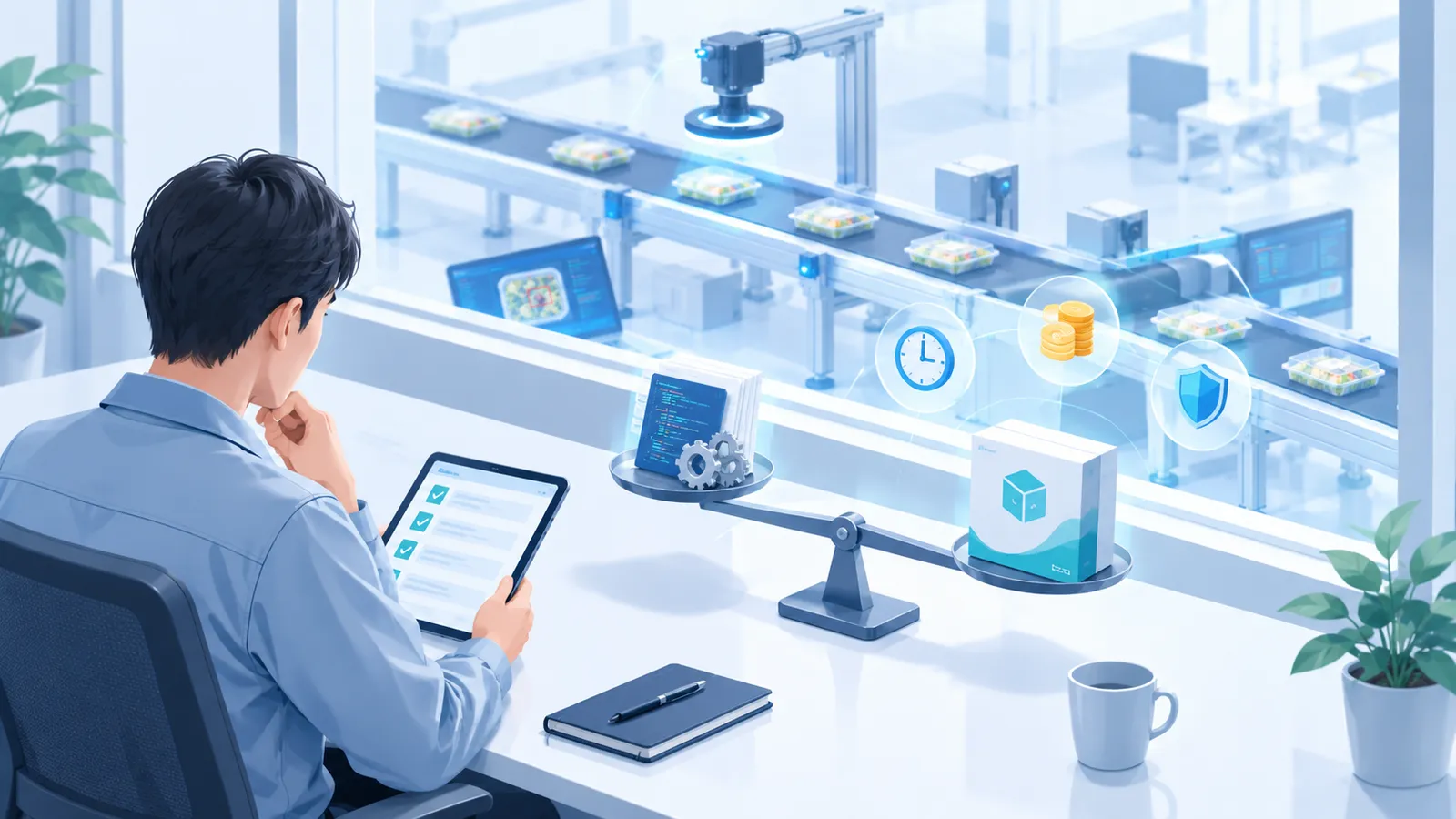
What gets overlooked most easily: the cameras, the lighting, the jigs, the transport and ejection mechanisms, the integration with the equipment cost the same whether you build the software or buy it. Which means what building in-house saves is only the part of the total that corresponds to a software licence. That saving is what has to be weighed against the salary cost of development and maintenance.
Licences and information management
Some of the AI widely used for object detection is published under a licence. Depending on how you use it, though, you may incur an obligation to disclose source code, or need to consider a commercial licence. Pre-trained models and public datasets come with their own terms. And whether product images or drawings may be fed into a cloud generative AI service during development has to be checked against your own information management rules.
Questions to answer before committing
Drawing the above together, here are the questions worth answering. Use them for an internal review, or as material for a report to management.
| Aspect | The question |
|---|---|
| The whole inspection | Can you put the flow into words, from the capture trigger through judgement to ejection, including the concrete logic? |
| Hardware | Can you take responsibility in-house for choosing the lighting and cameras, and for communication with a PLC and other equipment? |
| Changing variants | Will the variants increase or change? Can you design with that in mind? |
| Evaluation | Can you secure enough NG samples to evaluate accuracy? |
| Maintenance | If the person in charge leaves, is there someone to take over maintenance and modification? |
| Accountability | Can you explain the grounds for a judgement, and the history of setting changes, to quality assurance or to a customer? |
| Cost | Does the saving on software purchase exceed the salary cost of development and maintenance? |
If you can answer those with confidence, building in-house is well worth considering. If several of them give you pause, that is a sign to look at buying inspection software or talking to someone who does this.
In closing: generative AI replaces the writing, not the thinking
What generative AI takes over is writing the code. What to inspect and how, and how to prepare for variation and for changes of variant, is still left to people. For someone who can already see the concrete logic, generative AI is a powerful tool.
The inspection software sold as a product, meanwhile, is exactly what came out of meeting these difficulties on a great many factory floors. The knowledge needed to design an inspection, and the apparatus for changes of variant and for running it, are built in. If you cannot yet see what to do and how, using a product with that knowledge in it will usually be the shorter road.