How far can generative AI take you towards building inspection software? The question is whether you can think of it as a system
How far generative AI takes you — and why the system matters more than the software
What this article covers
Generative AI has brought software within reach of people who are not programming specialists, and inspection software is no exception. This article sets out honestly how far generative AI can take you towards building it, the view you should hold before considering building your own — that visual inspection is a system — and what know-how and technology is already packed into the inspection software on the market.
When someone says you do not need to buy software any more
“With generative AI we can build the inspection software ourselves; we do not need to buy it.” Some people have been told this by their management and are wondering how to answer. Others, in production engineering at a manufacturer, suspect they could do it themselves now.
The short answer: the idea is not wrong at all. How realistic it is, though, depends enormously on who is building what.
The range generative AI can cover is wider than you might think
Rule-based judgement is quite realistic
Extract the regions of a particular colour and call it NG if the area exceeds a threshold. Or align by pattern matching and judge on the total area of pixels above an RGB threshold. Building that kind of rule-based inspection logic by instructing a generative AI is not especially hard. There is plenty of material about image processing libraries on the internet, and it is the sort of thing generative AI is good at.
Object detection and segmentation can be built locally now
Even AI models — object detection trained on defects, segmentation that extracts the defective region — can plausibly be built locally if you can get hold of a GPU machine, at least in simple form. Work that a few years ago needed a specialist engineer now has a much lower barrier, with generative AI helping.
If you want to rebuild part of software you already use, you can get surprisingly far
Someone who has used inspection software and wants to build one particular function themselves may get surprisingly far with generative AI, because they can already see the shape of the inspection. That is how much potential the tool has.
Visual inspection is not software; it is a system
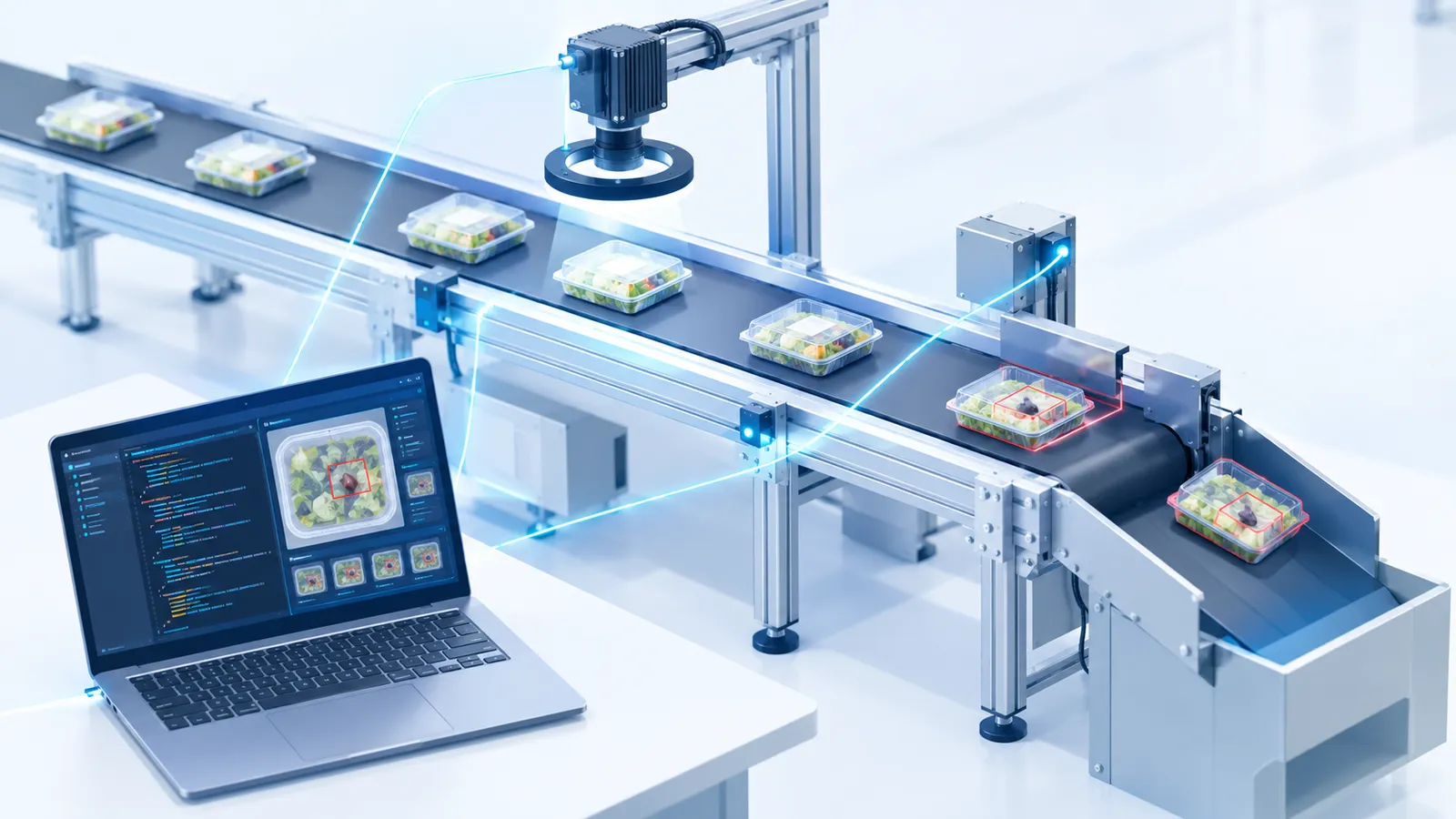
On the other hand, if you are automating a manual inspection for the first time and go straight to building inspection software with generative AI, the barrier rises sharply. The reason is that visual inspection is not software on its own but a system, including the capture equipment, the transport mechanism and the external devices.
What replacing a manual inspection on a conveyor involves
Say products on a conveyor are inspected by eye today. To replace that with inspection software, at least the following have to be decided.
- When to capture: how you detect that the product has reached the right position, and how you tell the camera to shoot
- What to inspect: how many cameras, at what angles, to cover the whole product
- How to judge: which image processing or AI, and against what criteria OK and NG are decided
- How to eject: how an NG part is taken off the line, and how that signal reaches the equipment
Then, for each of those, you have to work out what the software needs to do and implement it, one piece at a time.
Dividing what the software does from what the hardware does
In visual inspection it is barely an exaggeration to say that most of the result is decided at the stage of the capture environment: the lighting, the camera, the lens. If the defect is not properly in the image, no amount of clever logic will find it. What do you solve in hardware and what do you process in software? Have a generative AI write code without a feel for that and you will struggle to reach the result you wanted.
Some areas generative AI is poor at
Industrial camera SDKs and PLC communication specifications differ by manufacturer, and the documentation is often behind a members-only login. Where little is published, the accuracy of a generative AI’s answers falls, and it is common enough to get the judgement logic working and then come unstuck at the connection to the equipment.
What is already packed into existing inspection software
Even as the range generative AI can cover widens, there are areas that building it yourself will not reach, because existing inspection software has a great deal in it that came out of running on a great many factory floors.
You cannot instruct a generative AI about a tool you have never heard of
Existing inspection software comes with a range of tools for inspection: pre-processing, position correction, setting the inspection region. These were born out of solving problems on the floor one at a time — operational know-how, crystallised.
Someone who knows those tools exist and where they apply can tell a generative AI concretely: apply this pre-processing, then judge this way. You cannot ask for what you do not know exists. Generative AI answers a precise question precisely, but what to ask is left to the person asking.
The ideas are in the speed as much as the accuracy
On a volume line, processing speed matters as much as accuracy. However correct the judgement, it is unusable if it does not fit the takt. Existing software carries a great many devices for speed: narrowing the inspection region, parallelising, using the GPU efficiently, making the model lighter. They were sharpened against the wall of speed on real lines. Code a generative AI writes puts working first, so as written it will often not keep up with the line.
Proprietary technology that was never published cannot be reached by building it yourself
Each company’s inspection software also contains proprietary technology that has not been published in papers or as open source. We, for instance, have our own Zero-Training AI.
Want AI inspection but cannot collect defects? That is what Zero-Training AI is for
What a generative AI has learned is, in essence, what has been published. It cannot reproduce what was not, and this is an area building it yourself will not reach.
In closing
Generative AI has real potential in building inspection software too. It shows that potential when you can already picture the flow from capture through judgement to ejection, including the concrete logic. If you can see what to do and how, there is every chance generative AI can realise it.
Being able to build it and being able to keep using it on a factory floor are different questions, though. The costs and risks people tend to overlook when considering building in-house are covered in the article below.
The costs and risks to know before building inspection software yourself